- Get 50% OFF Your First Consultation – Limited Time Offer!

Quick Summary :- A successful Meta Ads campaign needs more than simply boosting a post and adding a budget. The campaign objective, audience, creative, offer, landing page, tracking and overall structure all affect performance. The key is to identify where users are dropping off, fix the right part of the journey, and optimize based on meaningful business results rather than impressions or cheap clicks alone.
You have created a Meta ad. You have selected your audience. You have added a budget. You clicked Publish.
But after spending money, you are not getting enough website visitors, enquiries, or sales.
So, what went wrong?
The problem may not be with Meta Ads itself. It could be your campaign objective, audience, ad creative, offer, landing page, tracking, or even the way the campaign is structured.
A successful Meta Ads campaign needs more than simply boosting a post and waiting for results.
In this guide, we'll explain how to set up a proper Meta Ads campaign, what to check when your ads aren't getting traffic, and how to improve your campaign step by step.
Before changing everything, identify where the problem is.
There are several common reasons:
The first step is to find where the problem is happening.
Think of your campaign like this:
Ad Impression → Click → Website Visit → Enquiry/Purchase
If people aren't clicking, look at the ad.
If people click but don't stay or convert, look at the landing page and offer.
Tips: Diagnose the stage where users are dropping off before changing the campaign. Fixing the wrong part can waste both time and advertising budget.
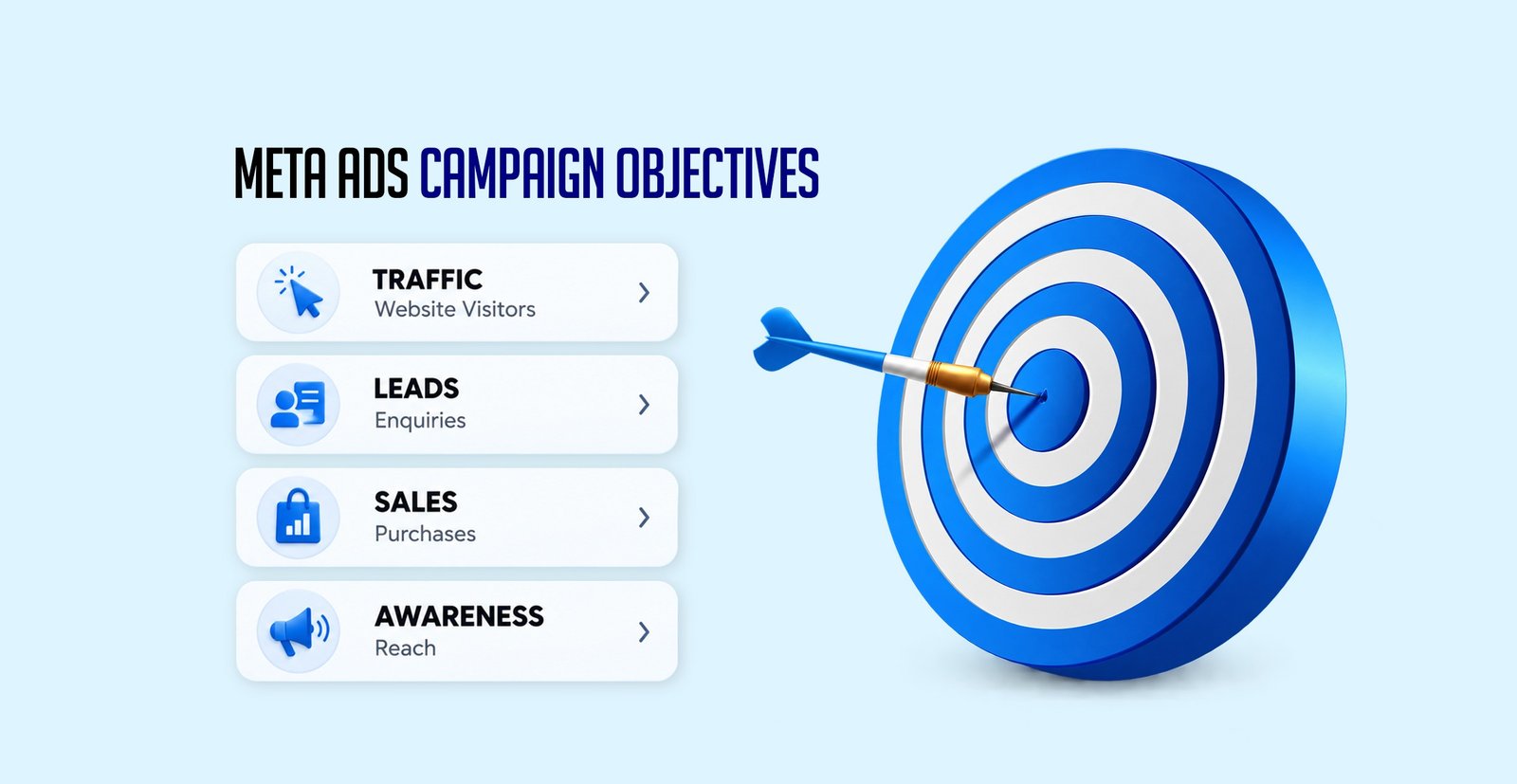
One of the first decisions you make in Meta Ads is your campaign objective.
Your objective should match what you actually want from the campaign.
Want Website Visitors?
Choose an objective focused on Traffic.
Want Leads?
Use a Leads objective and decide whether you want leads through your website, instant forms, calls, or another available conversion path.
Want Sales?
Use a Sales objective when the goal is to drive purchases or other sales-focused conversions.
Want Brand Awareness?
Use an objective designed to increase awareness and reach.
Tips: Don't choose an objective because it sounds popular. Choose the objective that matches the actual business result you want from the campaign.
A Meta Ads campaign generally has three important levels:
Campaign
This is where you define the overall marketing objective.
Ad Set
This is where you work on things such as audience, budget, schedule and placements, depending on the campaign setup.
Ad
This is the actual creative people see.
Think of it like:
Campaign → Ad Set → Ad
Keeping this structure clear makes your campaign easier to manage and test.
Tips: Keep your account structure simple enough that you can clearly understand what audience, creative and objective are producing the result.
Don't try to achieve everything with one campaign.
Bad approach:
"I want traffic, followers, leads, engagement and sales."
Instead, choose one primary goal.
For example:
Goal: Generate enquiries for digital marketing services.
Now your campaign, audience, creative, landing page and measurement can all support that goal.
Tips: One clear campaign objective makes every other decision easier — audience, creative, CTA, landing page and measurement can all point toward the same outcome.
Your audience should match the people who are most likely to need your product or service.
You can consider:
For a local business, location can be especially important.
For example, if you're promoting a service only available in Chandigarh, you probably don't want to spend your entire budget showing the ad across India.
At the same time, don't make the audience unnecessarily narrow.
Meta's delivery system needs enough room to find people who are likely to take the action you're optimizing for.
Tips: Target for relevance, not maximum restriction. An audience can be too broad, but it can also become so narrow that campaign delivery and optimization suffer.
Getting impressions doesn't mean you're going to get traffic.
Your ad needs to answer one simple question:
"Why should I click this?"
A good ad usually has:
A Strong Hook
Grab attention quickly.
For example: Not Getting Enough Leads From Your Website?
A Clear Benefit
Tell people what they can get.
Get a Free Website & SEO Audit
A Clear CTA
Tell them what to do next.
Get Your Free Audit
Avoid putting too much information into one creative.
One ad should communicate one clear message.
Tips: If your ad cannot communicate the problem, benefit and next step quickly, simplify it. Clarity usually performs better than trying to say everything at once.
Meta users consume content quickly.
Your creative needs to work within that environment.
You can test:
Don't assume one format will always perform best.
Create a few variations and compare the results.
Tips: Test the message as well as the format. A different video style won't fix an offer or hook that does not resonate with the audience.
This is one of the biggest mistakes advertisers make.
Imagine someone sees your ad:
Get More Leads With Digital Marketing
They click the ad.
But the website takes them to a generic homepage with:
You may get the click, but you may lose the customer.
Your landing page should match your ad.
Ad:
Get a Free SEO Audit
Landing Page:
Get Your Free SEO Audit
Then explain:
Tips: Maintain message continuity from ad to landing page. The visitor should immediately recognize the same offer they clicked on.
Don't run a serious campaign without knowing what happens after the click.
Depending on your setup, you may need to configure:
Tracking helps you understand whether your ads are actually generating meaningful actions rather than simply clicks.
This is particularly important when your campaign is optimized for leads or sales.
Tips: Configure and test tracking before increasing campaign spend. If conversion data is unreliable, your optimization decisions can also become unreliable.
Your budget should be based on your objective, audience, expected conversion cost, and testing requirements.
Don't start with:
"I'll spend ₹500 today and decide whether Meta Ads work."
One or two days usually won't tell you enough.
Instead, give your campaign enough budget and time to collect useful data.
The goal is not simply to spend less.
The goal is to understand: How much does it cost to generate a useful result?
For example: ₹500 spent → 100 clicks → 5 leads
is much more useful information than simply saying: ₹500 spent → lots of impressions.
Tips: Evaluate budget against cost per meaningful result, not just daily spend. A higher-spend campaign can still be more efficient if it produces better-quality leads or sales.
This is another common mistake.
You launch the campaign.
After a few hours: "No leads. Let's change the audience."
A few hours later: "Let's change the creative."
Then: "Let's change the budget."
Now you're changing several variables at once.
Give the campaign enough time to generate meaningful data, unless there is an obvious technical or policy problem.
When you test, try to understand what variable you're actually testing.
Tips: Change one major variable at a time whenever practical. Otherwise, you may improve performance without knowing what actually caused the improvement.
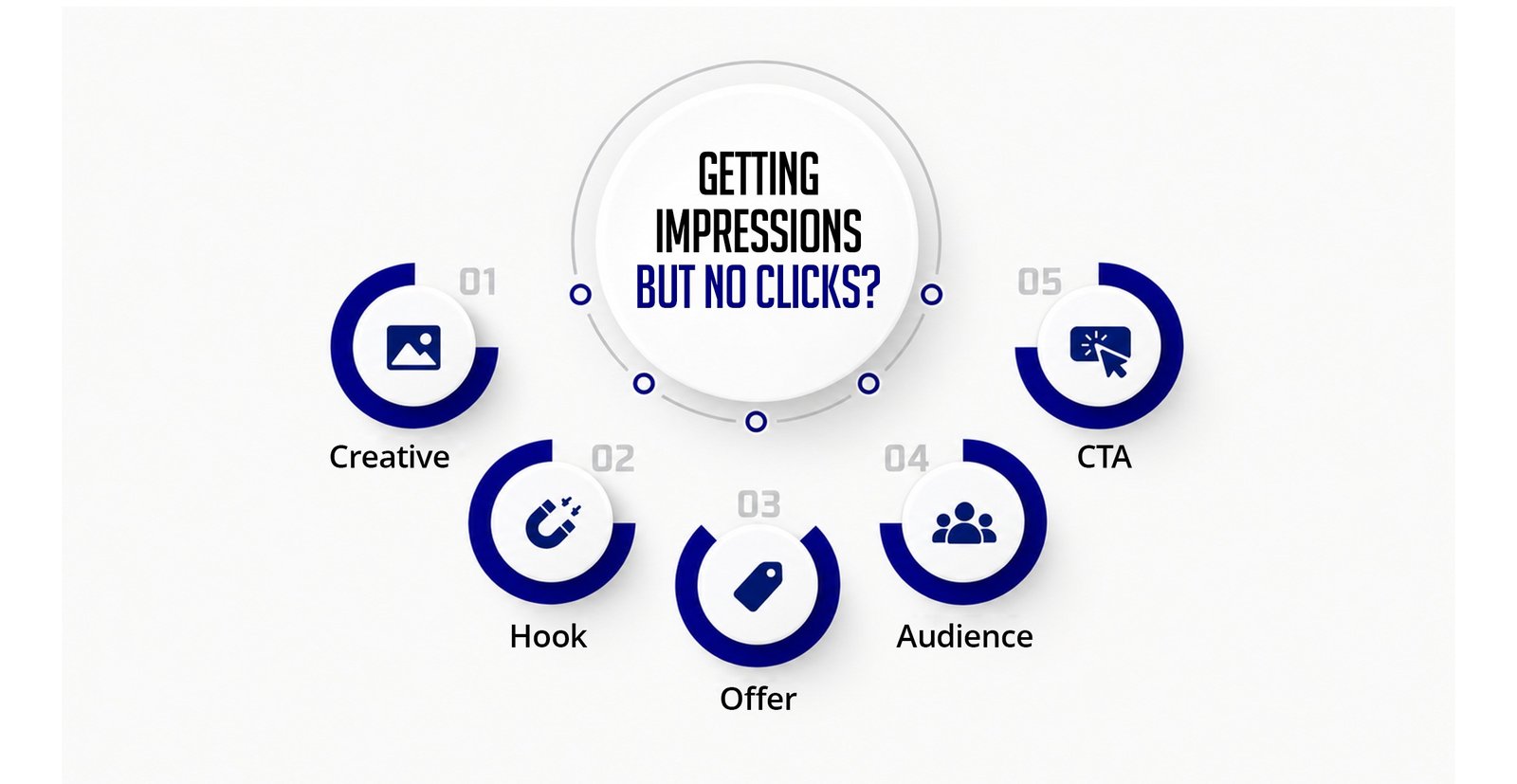
If your ad is being shown but people aren't clicking, check:
1. Creative
Is the image or video interesting?
2. Hook
Does the first line grab attention?
3. Offer
Is there a genuine reason to click?
4. Audience
Are you reaching the right people?
5. CTA
Is the next step obvious?
For example, Learn More may be less compelling than Get Free Consultation when the offer is genuinely a consultation.
Tips: Impressions without clicks usually point to a relevance or communication problem. Review the audience, hook, offer and creative before increasing budget.
This is a different problem.
If people are clicking but not converting, investigate the post-click experience.
Check:
You may not need a new ad.
You may need a better landing page.
Tips: Separate ad performance from landing-page performance. If users are clicking, the ad may already be doing its job.
For a local service business, a simple campaign could look like this:
Campaign
Objective: Leads
Ad Set
Location: Chandigarh + relevant nearby areas
Audience: Relevant potential customers
Placements: Appropriate Meta placements
Ads
Ad 1: Problem-focused creative
Not Getting Enough Leads?
Ad 2: Benefit-focused creative
Turn Your Website Into a Lead Generation Machine
Ad 3: Offer-focused creative
Get a Free Digital Marketing Consultation
Landing/Lead Destination
Clear offer → Benefits → Trust → Form/CTA
This is much easier to understand and optimize than creating a different campaign for every small variation.
Tips: Use a structure that makes comparison easy. If every ad has a different audience, offer and destination, learning what worked becomes much harder.
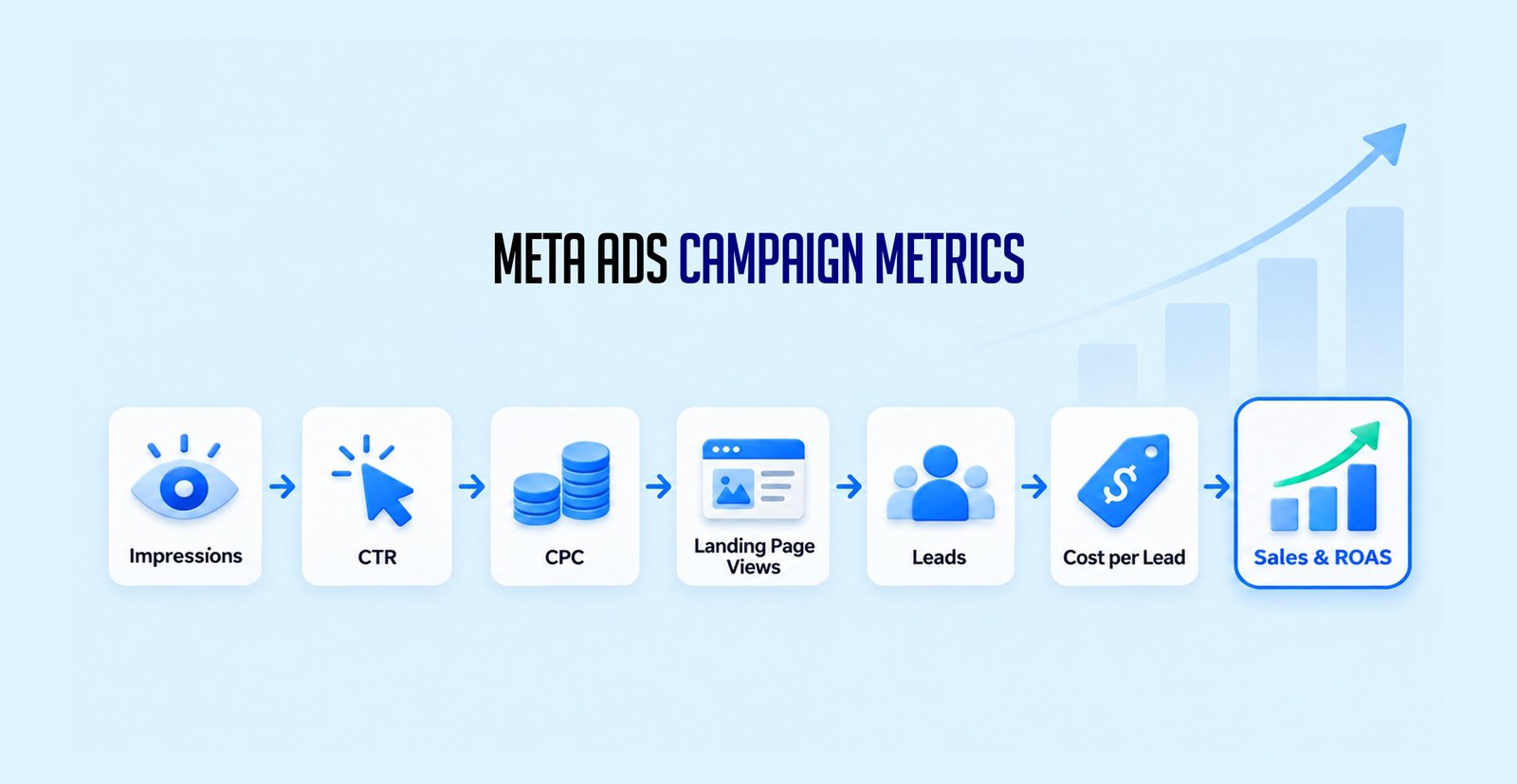
A common mistake is looking only at CTR or CPC.
Look at the complete journey:
Impressions
How often your ad was shown.
CTR
How often people clicked.
CPC
Cost of each click.
Landing Page Views
Whether people actually reached the page.
Leads
Number of enquiries.
Cost per Lead
What you're paying for each lead.
Sales
Actual business results.
ROAS
Revenue generated relative to ad spend.
The most important metric depends on your campaign objective.
Cheap clicks aren't necessarily good clicks.
You ultimately want useful traffic and business results.
Tips: Measure the metric closest to the business outcome. For lead-generation campaigns, cost per qualified lead is often more meaningful than CPC alone.
Boosting Every Post
Boosting a post isn't the same as building a properly planned advertising campaign.
Choosing the Wrong Objective
Your campaign objective should match the result you're trying to achieve.
Targeting Too Broad or Too Narrow
Your audience should be relevant without unnecessarily restricting delivery.
Using the Same Creative for Too Long
People can become less responsive when they repeatedly see the same creative.
Sending Everyone to the Homepage
A dedicated landing page can often provide a clearer next step.
No Tracking
Without proper tracking, it's difficult to understand what's actually working.
Changing Everything at Once
If you change the audience, creative, budget and landing page simultaneously, you won't know what made the difference.
Tips: Simplify before scaling. A clean structure, clear objective and reliable tracking are more valuable than running many campaigns that you cannot properly evaluate.
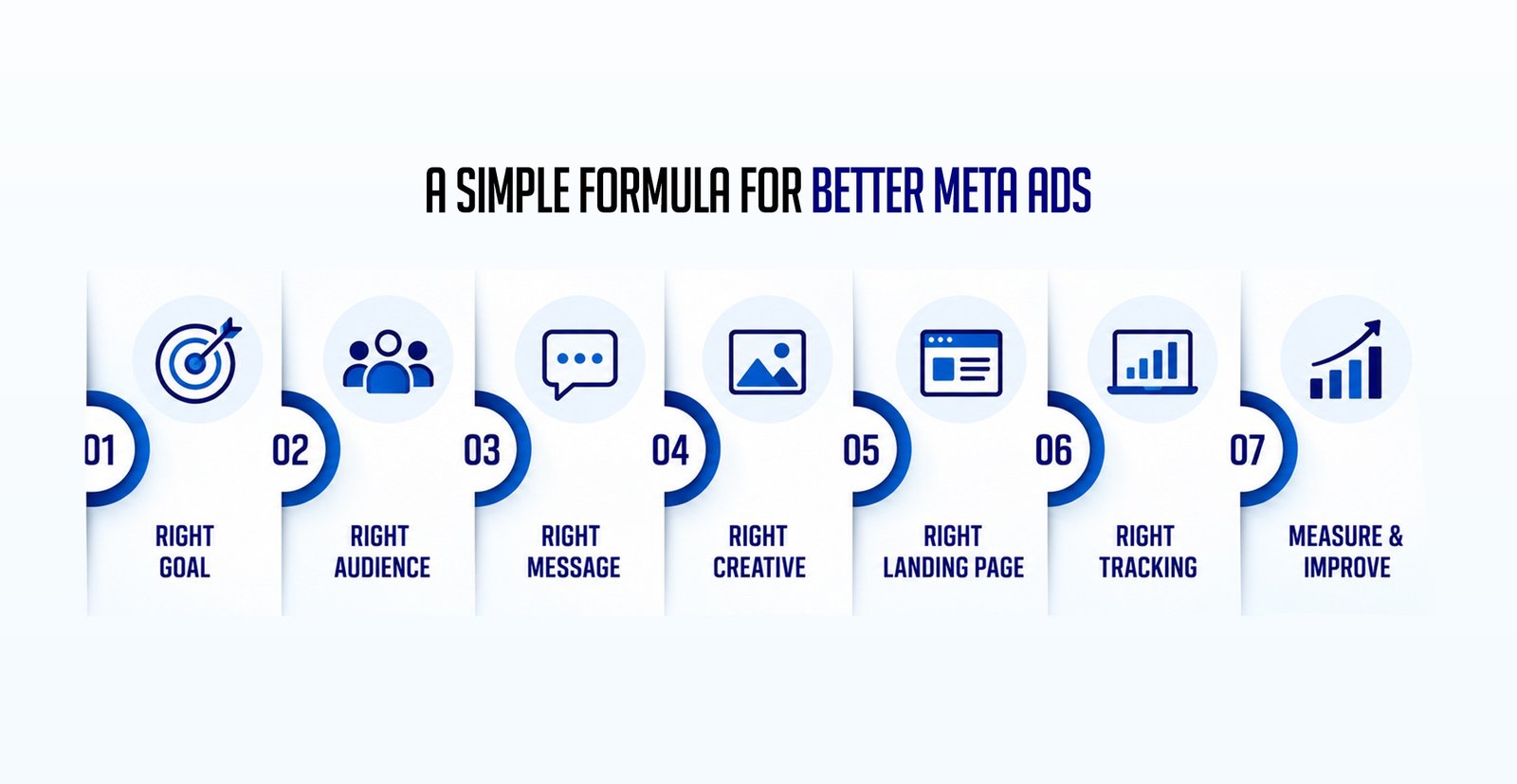
Before launching your next campaign, remember:
Right Goal
↓
Right Audience
↓
Right Message
↓
Right Creative
↓
Right Landing Page
↓
Right Tracking
↓
Measure & Improve
If one part is weak, the entire campaign can suffer.
Tips: Meta Ads performance is rarely about one isolated setting. Strong campaigns come from alignment across the complete customer journey.
Running Meta Ads is easy.
Running them properly is different.
If you're getting impressions but no clicks, your problem may be the creative, message or audience.
If you're getting clicks but no leads, look at your landing page, offer and conversion process.
And if you're getting leads but no customers, the problem may be further down the sales journey.
The best Meta Ads campaigns are not created by simply increasing the budget. They are built by matching the right objective, audience, message, creative and landing experience—and then improving them using real data.
A strong Meta campaign needs more than an attractive creative. Your objective, audience, offer, landing page, tracking and follow-up process all need to work together.
Agyle Studio can help connect paid advertising with creative strategy, landing-page design, digital marketing and campaign optimization.
Comments are closed